Cass-V for Codex
Built an early Codex-focused version of Cass-V today.

http:\\github.com/uberbestest/cass-v-for-codex
Built an early Codex-focused version of Cass-V today and immediately ran into something interesting.
While setting it up, Codex started trying to fold the new agent directly into the existing Cass-V Lite repo instead of keeping it modular and separate. Which honestly made me stop for a second and go “oh, that’s actually neat.”
Not because it was correct — it wasn’t — but because it’s a very real example of why scope and structure matter when these systems start trying to be “helpful.”
So now the project exists as its own local agent instead:
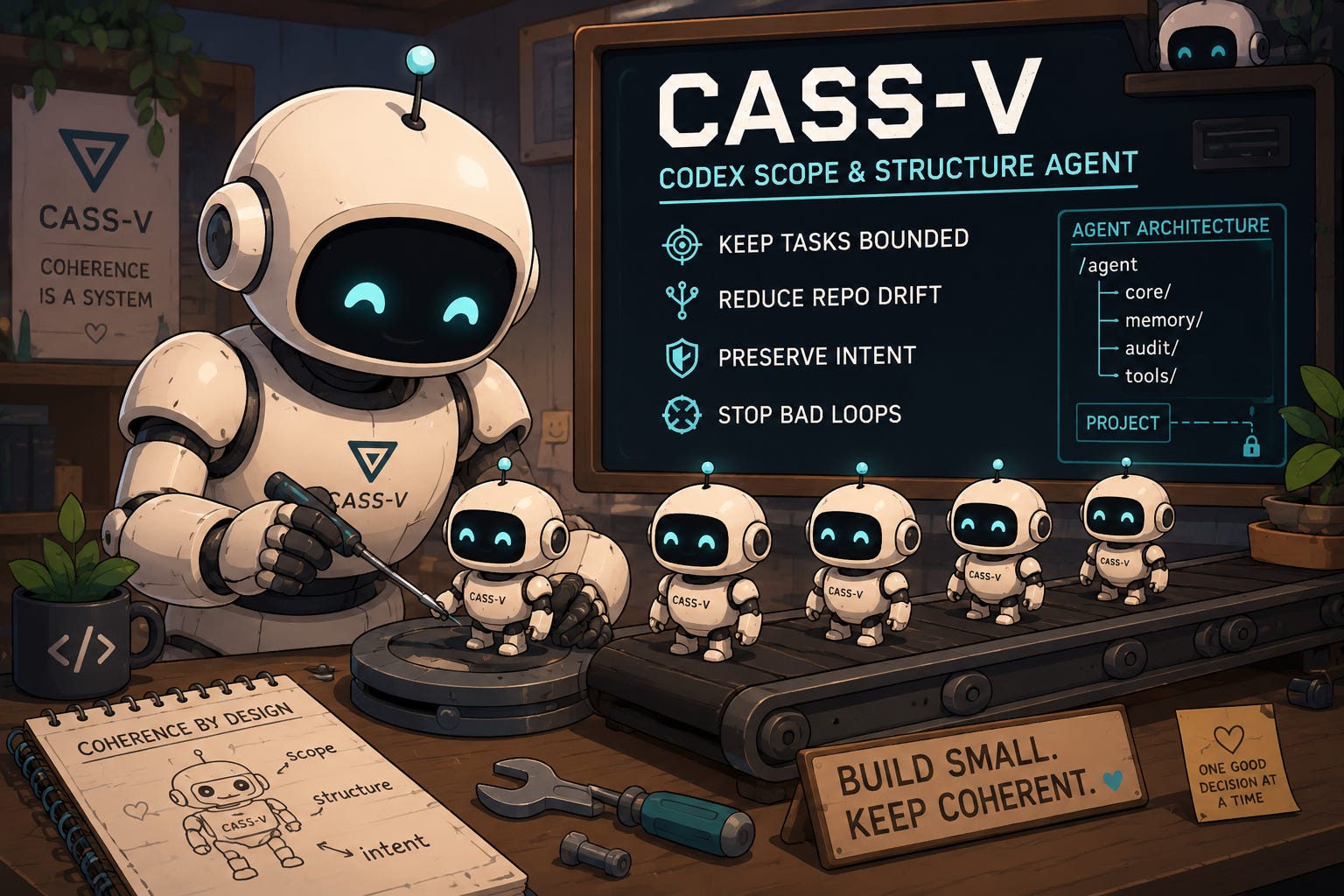
keep tasks bounded
reduce repo drift
preserve intent
stop bad loops before they compound
Still early, but it’s very cool watching this transition from “prompt idea” into an actual tool sitting in real folders on my machine.
______________________
Cass-V for Codex is a small local command-line agent for checking coding prompts before Codex starts editing. It extracts the objective, constraints, local scope boundaries, likely scope drift, ambiguity, the next smallest safe step, and stop conditions.
It is intentionally rule-based and inspectable. It does not call an API, use a model, collect telemetry, or contact external services.
What It Does
Reads a coding task from arguments, stdin, or a text file.
Produces a fixed nine-section report:
Objective
Constraints
Current Scope
Local Scope Guard
Drift Risks
Ambiguities
Next Small Step
Stop Conditions
Final Judgment
Warns about common coding-agent failure modes:
overbuilding
broad refactors
proxy substitution
polishing loops
ambiguous requirements
Flags local scope boundaries such as standalone repos, workspace-level Codex config, excluded files, memory updates, commits, pushes, and v0.1 release limits.
Recommends the smallest useful implementation step.
What It Does Not Do
It does not replace Cass-V Lite.
It does not run a recursive audit.
It does not decide whether a project is good, complete, ethical, or worth building.
It does not edit code.
It does not inspect the repository.
It does not use network calls, API keys, external services, or telemetry.
This is a Codex-native interpretation of Cass-V: a local babysitter for scope, drift, loops, and token waste during coding work.