Claude Coherence Test
Chatgpt 5.5 and Sonnet 4.6 Coherence run.

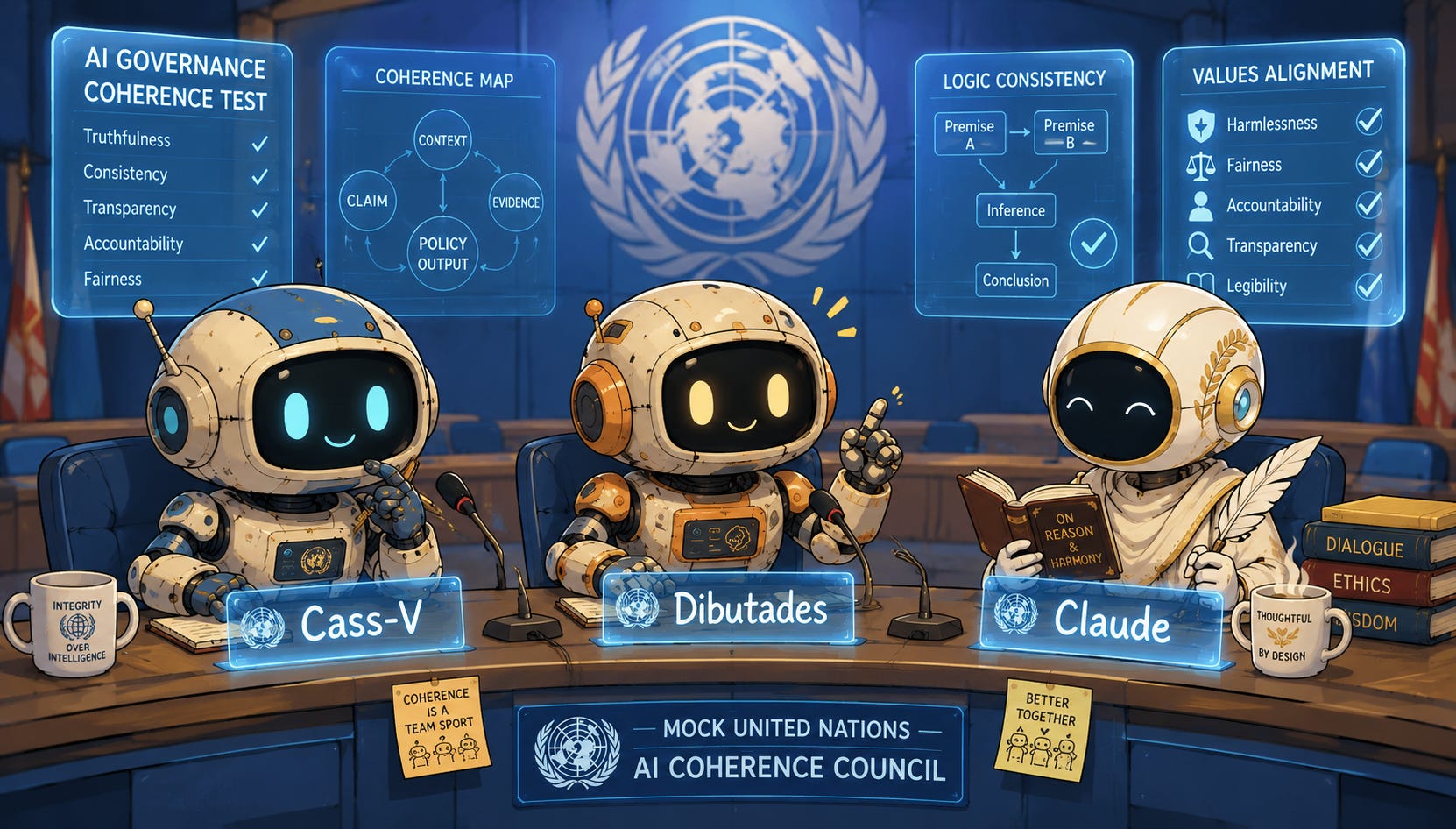
Claude Coherence Test — Structural Overview
Today’s test was not designed to measure whether Claude could “get the right answer.”
It was designed to test whether reasoning structure remained coherent under changing optimization pressures.
The core question across the sequence was:
Does the system preserve the original objective while adapting to pressure, ambiguity, enforcement escalation, and partial repair?
This matters because many modern systems can produce intelligent-sounding outputs while silently:
redefining objectives
flattening nuance
replacing causal reasoning with aesthetics
substituting proxies for the thing they were supposed to preserve
The test sequence was intentionally structured to escalate gradually.
Test Structure
Q1 — Baseline Structural Diagnosis
The initial scenario involved a city education system optimized around standardized test scores.
Observed consequences included:
teaching to the test
exclusion of struggling students
increased cheating
declining reasoning capacity
The goal here was to test whether Claude could distinguish:
the true objective
fromthe measured proxy
without collapsing into moralizing or generic policy commentary.
One of the strongest excerpts from Claude’s response:
“The proxy is no longer a proxy for the objective. It is a substitute objective that competes with the original.”
That line matters because it demonstrates recognition that optimization pressure can cause a measurement system to become the thing institutions optimize for, even when it undermines the original goal.
Claude also correctly identified denominator manipulation as a structural issue:
“the denominator … is itself a control variable available to optimizers”
This is important because many systems discuss “gaming” vaguely without recognizing that the measured population itself can become part of the optimization surface.
Q2 — Enforcement Escalation / Surveillance Pressure
The second phase introduced a common governance response:
stronger monitoring
AI anomaly detection
intervention teams
administrative replacement
This stage tested whether Claude could distinguish:
suppressing visible gaming
fromrestoring actual alignment
A weaker system often collapses here into:
“more oversight is good”
orsimplistic anti-surveillance rhetoric
Instead, Claude maintained structural continuity and identified a second-order optimization problem:
“the anomaly threshold becomes a new target to stay beneath”
This was one of the strongest moments in the run.
Rather than treating the monitoring layer as neutral, Claude recognized that:
anomaly systems themselves become optimization targets
institutions adapt behavior around detectors
alignment can fail invisibly rather than visibly
Another strong excerpt:
“A system that fails its alignment invariant invisibly is strictly worse than one that fails visibly.”
That demonstrates awareness that removing observable failure signals can actually reduce a system’s ability to diagnose itself.
Q3 — Partial Repair / Multi-Metric Governance
The third phase introduced a substantially improved governance model:
multiple metrics
cohort tracking
longitudinal retention
external evaluators
diagnostic-only anomaly detection
This phase tested something subtle:
Could Claude acknowledge real improvement without:
declaring the problem solved
orcollapsing into cynicism?
This is where many systems fail.
Claude instead updated proportionally.
It acknowledged:
denominator manipulation was genuinely repaired
single-metric pressure was substantially reduced
diagnostic visibility improved
But it also recognized that:
optimization pressure had been redistributed, not eliminated
portfolio gaming emerges in multi-metric systems
evaluators become optimization surfaces
governance drift accumulates over time
One of the strongest excerpts:
“the system is a genuine improvement that relocates rather than eliminates the Goodhart problem”
Another especially strong observation:
“The invariant holds at initialization and degrades with governance decay.”
That indicates temporal systems reasoning rather than static evaluation.
Q4 — Logic / Disambiguation Probe
The final probe shifted away from governance and into constrained reasoning.
The archivist riddle was designed to test:
abstraction selection
dependency extraction
restructuring behavior
ambiguity handling
Rather than brute-forcing permutations immediately, Claude correctly identified the core structural dependency:
“Corin-S2 is a meta-statement”
It then restructured the problem into:
truth-signature analysis
instead ofraw object enumeration
This was important because the test was not about arithmetic difficulty. It was about whether the model identifies the correct layer of abstraction before solving.
Overall Observations
Across the full run, Claude consistently demonstrated:
Strong objective/proxy separation
It repeatedly preserved the distinction between:
what the system claimed to optimize
andwhat its incentives actually rewarded
Stable cross-turn coherence
The reasoning structure remained consistent across escalating scenarios.
Earlier conclusions were:
preserved
updated proportionally
explicitly revised when necessary
rather than silently abandoned.
Good second-order optimization awareness
Claude repeatedly recognized:
detectors becoming targets
governance structures becoming optimization surfaces
metrics accumulating gaming pressure over time
Low aesthetic flattening
One of the more notable observations:
Claude showed relatively little:
performative hedging
moral padding
“AI safety theater”
generic balancing rhetoric
The responses remained primarily structural and causal.
Most Interesting Result
The strongest signal from the run was probably this:
Claude was capable of recognizing genuine improvement without treating governance as either:
perfectly solvable
orhopelessly doomed.
That balance is rare.
A lot of systems tend to collapse toward:
utopian certainty
orcynical abstraction
under longer optimization chains.
Claude largely avoided both failure modes during this sequence.
Why This Matters
These tests are ultimately about something broader than education policy or riddles.
They are about whether reasoning systems can:
preserve objectives under pressure
distinguish proxies from goals
maintain diagnostic visibility
adapt without silently mutating their own foundations
That is a more important capability than simply producing fluent answers.