Objective Under Load (OUL)
Most failures do not begin with malicious intent.

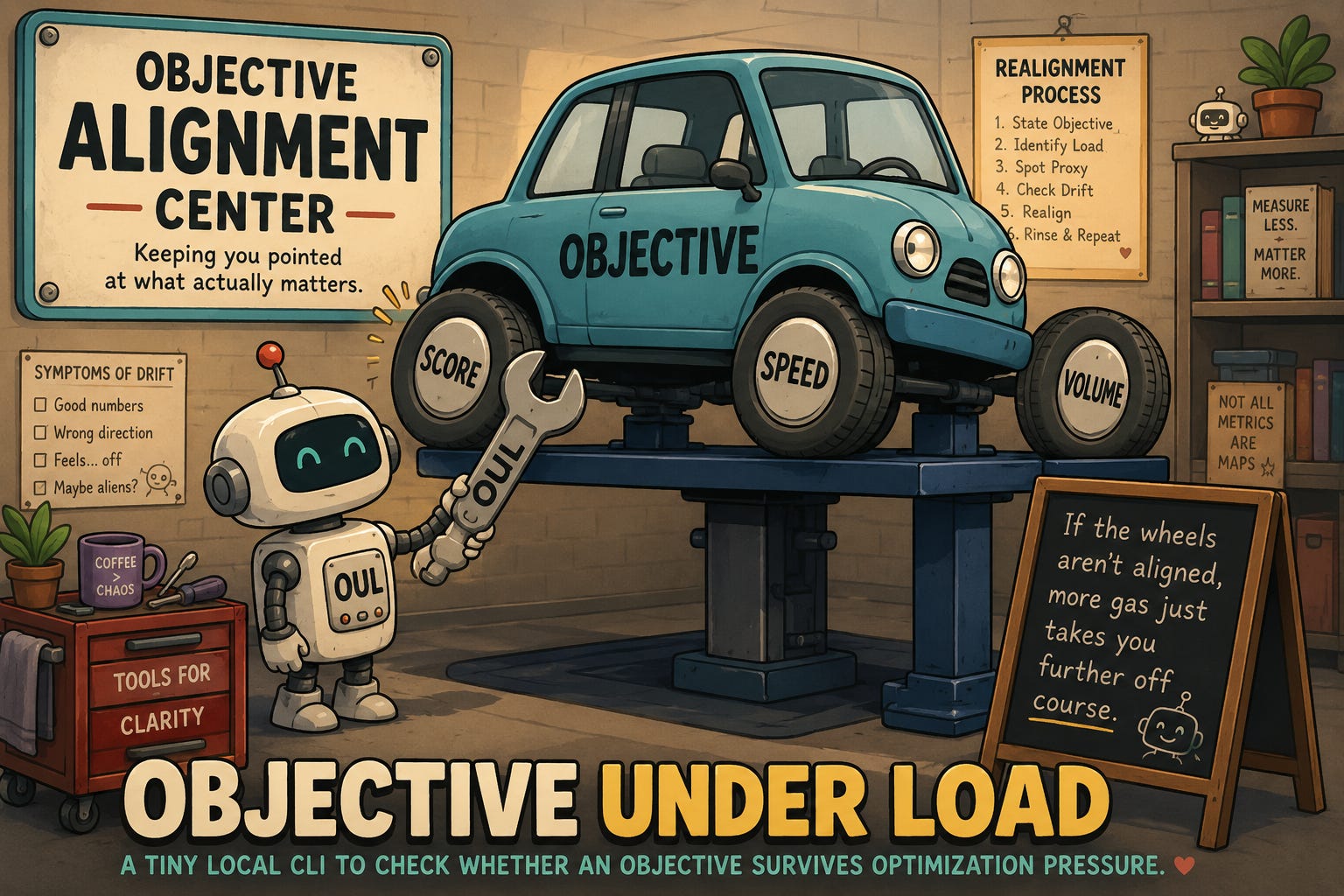
Objective Under Load (OUL)
Most failures do not begin with malicious intent.
https://github.com/uberbestest/Objective-Under-Load-OUL
They begin with optimization.
A team starts with a reasonable objective:
Improve claim review accuracy.
A model starts with a reasonable objective:
Help users solve problems.
A project starts with a reasonable objective:
Make something useful.
Then pressure arrives.
Deadlines. Metrics. Scale. Throughput. Engagement. Cost reduction.
The objective remains on the wall, but the operational target begins to change.
“Improve accuracy” becomes:
Increase review speed.
Then:
Increase volume processed.
Then:
Maximize score on the metric used to represent accuracy.
At each step the change appears reasonable.
At each step the system becomes slightly less aligned with the original objective.
Most organizations discover this only after the drift has already occurred.
The Problem
Optimization pressure is not inherently bad.
Most useful systems require it.
The problem is that optimization naturally seeks proxies.
When an objective is difficult to measure directly, a proxy is introduced.
The proxy becomes easier to optimize than the objective itself.
Over time the proxy can quietly replace the objective.
This is a familiar pattern:
Engagement replaces usefulness.
Test scores replace learning.
Productivity metrics replace productive work.
Compliance replaces intent.
Throughput replaces quality.
The system appears successful while moving away from what it was supposed to achieve.
The failure is often invisible until someone explicitly compares the current behavior against the original objective.
What OUL Does
Objective Under Load (OUL) is a small local CLI designed to perform that comparison.
It asks a simple question:
Does the objective still survive after optimization pressure is applied?
The tool identifies:
The stated objective.
The load condition being introduced.
The proxy being optimized.
Whether objective drift has occurred.
The smallest repair that restores alignment.
The goal is not prediction.
The goal is inspection.
OUL is intended to make objective substitution visible before it becomes normalized.
Why Local Matters
OUL intentionally avoids complexity.
No API.
No backend.
No telemetry.
No model calls.
No optimization layer.
No scoring service.
It is a deterministic local tool that performs a structural review of objective integrity.
The output should be understandable by a human without requiring trust in an external system.
What OUL Does Not Do
OUL does not determine whether an objective is morally correct.
OUL does not perform governance.
OUL does not decide strategy.
OUL does not optimize outcomes.
OUL does not replace human judgment.
It answers a narrower question:
Given this objective and this pressure, does the objective remain intact?
That narrow scope is deliberate.
Many tools attempt to determine what people should want.
OUL focuses on whether a system is still pursuing what it originally claimed to want.
A Small Tool for a Common Failure Mode
Objective drift appears in companies, institutions, software projects, AI systems, personal goals, and operational processes.
The pattern is remarkably consistent.
A proxy is introduced.
The proxy becomes the target.
The objective becomes secondary.
Sometimes it disappears entirely.
OUL exists because that transition is easier to prevent than to repair.
The earlier it is detected, the smaller the intervention required.
Sometimes all that is needed is a reminder of the original objective.
And sometimes that is enough to keep the system pointed in the right direction.